Sunday, November 23, 2008

Thursday, November 20, 2008
More playing with online spreadsheets.
Here's a cute example. This is an EditGrid spreadsheet that pulls book data from Amazon (including price in dollars), currency data from Yahoo, and then calculates the price in pounds of the books. It's a "calculator" meaning that I've set up only one field to be editable (the search term for the book, in the white cell) and you can change this in your local copy, without it changing my original.
Looks like spreadsheets really are evolving to be the online user-programmable dashboards which people can use to create and publish their own mashups and other software. Very exciting.
Here's a cute example. This is an EditGrid spreadsheet that pulls book data from Amazon (including price in dollars), currency data from Yahoo, and then calculates the price in pounds of the books. It's a "calculator" meaning that I've set up only one field to be editable (the search term for the book, in the white cell) and you can change this in your local copy, without it changing my original.
Looks like spreadsheets really are evolving to be the online user-programmable dashboards which people can use to create and publish their own mashups and other software. Very exciting.
Tuesday, November 18, 2008
So I created a CollabFinder profile.
Now, what would be really smart would be a way to import my StackOverflow rating into it.
Now, what would be really smart would be a way to import my StackOverflow rating into it.
Wednesday, November 12, 2008
PythonCard, the Hypercard / VB-like python development environment maybe being forked and revivified.
Quick answer to the guy who used yesterday's Form Experiment to ask what's happening with SdiDesk ...
Here's the status report :
1) In the last couple of weeks I quit my job and moved back to the UK ... which has been taking up quite a lot of my time and energy.
2) Once we've settled in, I hope I can get some time to focus on my projects ... including SdiDesk (and GeekWeaver, MTC etc.) The good thing, no more distractions from my previous demanding day-job. The bad thing, after a brief holiday I need to find work in the UK. (Offers, tips and suggestions are, of course, welcome)
3) SdiDesk was converted to VB.NET this year. And the source-code in progress is available on Google Code.
4) I am NOT a VB.NET programmer, and frankly, from the little I've played with it so far, I'm not very excited about getting more involved. I admired VB exactly because the combined language + IDE made Windows programming mindlessly easy. Throw away that virtue (as VB.NET seems to have done, and I'm blaming the new, incredibly sluggish and cluttered VS2008 as much as changes to the language) and it has little to recommend it against other languages.
5) On the hand, I'm a pragmatist and often able to find something interesting pretty much anywhere. I also know that in a recession I may not be able to be too fussy when it comes to getting a job. So I will be spending a bit more time over the next month or so tidying up the VB.NET codebase, fixing some egregious issues, and making an installer. It's going to be useful to me to be able to say that I can operate in the VB.NET world, and produce working products.
6) Longer term, my preference and commitment is still to a Python SdiDesk-like thing. And most-likely a Python server with UI in the browser (javascript etc.) I've cooled towards the idea of Flex (mainly because my trial copy expired and I remembered all the problems of depending on proprietory software)
The attraction of anything other than the browser has always been the vector drawing in the network diagramming part of the software. But I'm sure that if I just wait a little bit longer, the browser will eventually be able to handle this too.
7) As always, I'm not unaffected by user feedback and other things going on in my life :-) ... if there's suddenly a surge in interest or demand for a VB.NET SdiDesk then I may reconsider.
8) Joe Question asks : "how risky is it to commit myself to SdiDesk.NET then? What about all my pages?" Answer : SdiDesk.NET reads your existing PageStore files. There may be some issues with the size of the diagrams, but everything works. If it doesn't, tell me.
However, you can't even try SdiDesk.NET currently unless you're a VB programmer because it's only available in source form. There will certainly be a build for end-users this year and it will read your existing PageStore. The main reason you want this is if you're an existing SdiDesk user who has moved (or will move soon) to Vista where the old VB6 version won't run.
I'm always committed to upgrade compatibility. You'll be able to move your existing SdiDesk pages to SdiDesk.NET, and you'll be able to import them into a future Python version.
Here's the status report :
1) In the last couple of weeks I quit my job and moved back to the UK ... which has been taking up quite a lot of my time and energy.
2) Once we've settled in, I hope I can get some time to focus on my projects ... including SdiDesk (and GeekWeaver, MTC etc.) The good thing, no more distractions from my previous demanding day-job. The bad thing, after a brief holiday I need to find work in the UK. (Offers, tips and suggestions are, of course, welcome)
3) SdiDesk was converted to VB.NET this year. And the source-code in progress is available on Google Code.
4) I am NOT a VB.NET programmer, and frankly, from the little I've played with it so far, I'm not very excited about getting more involved. I admired VB exactly because the combined language + IDE made Windows programming mindlessly easy. Throw away that virtue (as VB.NET seems to have done, and I'm blaming the new, incredibly sluggish and cluttered VS2008 as much as changes to the language) and it has little to recommend it against other languages.
5) On the hand, I'm a pragmatist and often able to find something interesting pretty much anywhere. I also know that in a recession I may not be able to be too fussy when it comes to getting a job. So I will be spending a bit more time over the next month or so tidying up the VB.NET codebase, fixing some egregious issues, and making an installer. It's going to be useful to me to be able to say that I can operate in the VB.NET world, and produce working products.
6) Longer term, my preference and commitment is still to a Python SdiDesk-like thing. And most-likely a Python server with UI in the browser (javascript etc.) I've cooled towards the idea of Flex (mainly because my trial copy expired and I remembered all the problems of depending on proprietory software)
The attraction of anything other than the browser has always been the vector drawing in the network diagramming part of the software. But I'm sure that if I just wait a little bit longer, the browser will eventually be able to handle this too.
7) As always, I'm not unaffected by user feedback and other things going on in my life :-) ... if there's suddenly a surge in interest or demand for a VB.NET SdiDesk then I may reconsider.
8) Joe Question asks : "how risky is it to commit myself to SdiDesk.NET then? What about all my pages?" Answer : SdiDesk.NET reads your existing PageStore files. There may be some issues with the size of the diagrams, but everything works. If it doesn't, tell me.
However, you can't even try SdiDesk.NET currently unless you're a VB programmer because it's only available in source form. There will certainly be a build for end-users this year and it will read your existing PageStore. The main reason you want this is if you're an existing SdiDesk user who has moved (or will move soon) to Vista where the old VB6 version won't run.
I'm always committed to upgrade compatibility. You'll be able to move your existing SdiDesk pages to SdiDesk.NET, and you'll be able to import them into a future Python version.
Tuesday, November 11, 2008
Friday, October 24, 2008
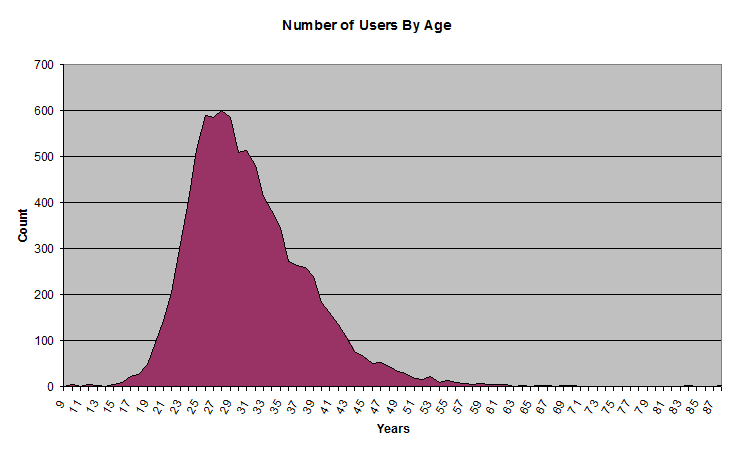
Age distribution of StackOverflow users (hat tip mfeathers)
I mentioned that I think StackOverflow is totally amazingly wonderful, right? :-)
I mentioned that I think StackOverflow is totally amazingly wonderful, right? :-)
Tuesday, October 21, 2008
Interesting. Reia's Tony Arcieri debunks Erlang's "single assignment" propaganda.
I guess someone could argue that once you have multiple assignment you're going to be more tempted to write a longer chain of actions as a sequence of statements rather than composing it out of multiple functions ... and this may be a bad thing.
But I've ranted often enough against languages which think its their job to constrain programmers that it better not be me who makes that argument.
Update : I'd like to see Frederik's question about closures (in the comments of that blog-post) answered though.
Update 2: Ulf Wiger points out that it got answered by Robert Virding later in the comments.
I guess someone could argue that once you have multiple assignment you're going to be more tempted to write a longer chain of actions as a sequence of statements rather than composing it out of multiple functions ... and this may be a bad thing.
But I've ranted often enough against languages which think its their job to constrain programmers that it better not be me who makes that argument.
Update : I'd like to see Frederik's question about closures (in the comments of that blog-post) answered though.
Update 2: Ulf Wiger points out that it got answered by Robert Virding later in the comments.
Follow on from yesterday's "Python / Haskell crossbreed" post. Both Al "Folknology" and Gleber point me at the Reia programming language. A Python / Ruby like scripting language on top of the Erlang Open Telecom Platform (Erlang's parallel virtual machine).
Very sweet ... I've subscribed to the mailing list to find out more.
Very sweet ... I've subscribed to the mailing list to find out more.
Monday, October 20, 2008
Prediction I made :
Don't know if I entirely believe that, but it's a good conversational gambit. And there's a certain logic to it if you look at the languages visually.
I'm personally, more into investigating Erlang at the moment, mainly because it seems more practical. The fast, parallel virtual machines are here and ready to go. But I could see myself looking back at Haskell too if it seemed to be gaining momentum.
I guess I also like the Erlang story on concurrency through message passing rather than transaction memories. And perhaps the whole typing thing is overdone in Haskell, although I can certainly see that it buys you more in that context than in, say, an OO language.
But I'd really love to see someone come up with mashup of the best bits of Python, Erlang and Haskell. It would *look* more or less like Python, although would find some-way to do multi-line lambdas etc. Like Haskell and Erlang it would have pattern matching arguments, functions defined over several definition statements, and immutable state. Like Erlang there'd be processes and messages as standard. Like Haskell, monads. Classes might be more like Haskell.
How might a language like this look?
Note that what's in brackets after the word Tree is neither a super-class (as in Python) nor a list of types as in Haskell nor a definitive list of field names. It's something more like information that a Tree is a tuple of three elements. And that by default they're called val, left and right.
These default names for the elements of the tuple can be over-ridden in functions which deconstruct a Tree using patterns. For example, the size function doesn't care about the initial val element and so leaves it blank.
I just thought of trying to make size a method of the class Tree. The syntax might then look something like this :
Where, obviously, the object itself is still (as in Python) explicitly passed as the first argument to the method, but instead of being called "self" we pick it up with the pattern of another Tree constructor and so it gets broken into _,left and right.
But where do we put the None / empty tree clause? My first thought was something like this :
But that's not quite going to work. If this really were a more statically typed language like Haskell, and we knew that left and right were always Trees, this would be OK. But as we're trying to go for Pythonic duck-typing we have a problem. We would still like left.size() to mean, "pass the method selector size() to the object left" and then let the class of left decide how to handle it. But where left is None we have no idea which class to use to call. We could have a multitude of classes which define size(None); which would we pick?
Note that this is not the pattern-matching's fault. We'd have the same problem here :
We could get around the problem by disallowing methods which take a single None argument, effectively forcing the programmer to write something like this :
But this starts looking somewhat clunky.
We might make it a bit less awkward by providing conditional evaluation to the left and right subtrees. Based on Python's current conditional expression syntax that would look something like this :
Or maybe we have to accept a static type system closer to Haskell's. Perhaps the types, in this case, contribute to Haskell's terseness.
I predict that in five years time, the hot language will either be a version of Python which has adopted ideas (Pattern matching arguments, Monads, immutability etc.) from Haskell; or a Haskell-like language which has borrowed some syntactic sugar from Python.
Don't know if I entirely believe that, but it's a good conversational gambit. And there's a certain logic to it if you look at the languages visually.
I'm personally, more into investigating Erlang at the moment, mainly because it seems more practical. The fast, parallel virtual machines are here and ready to go. But I could see myself looking back at Haskell too if it seemed to be gaining momentum.
I guess I also like the Erlang story on concurrency through message passing rather than transaction memories. And perhaps the whole typing thing is overdone in Haskell, although I can certainly see that it buys you more in that context than in, say, an OO language.
But I'd really love to see someone come up with mashup of the best bits of Python, Erlang and Haskell. It would *look* more or less like Python, although would find some-way to do multi-line lambdas etc. Like Haskell and Erlang it would have pattern matching arguments, functions defined over several definition statements, and immutable state. Like Erlang there'd be processes and messages as standard. Like Haskell, monads. Classes might be more like Haskell.
How might a language like this look?
 class Tree(val,left,right)
 def size(None) : 0
 def size(Tree(_,left,right)) :
    1 + size(left) + size(right)
Note that what's in brackets after the word Tree is neither a super-class (as in Python) nor a list of types as in Haskell nor a definitive list of field names. It's something more like information that a Tree is a tuple of three elements. And that by default they're called val, left and right.
These default names for the elements of the tuple can be over-ridden in functions which deconstruct a Tree using patterns. For example, the size function doesn't care about the initial val element and so leaves it blank.
I just thought of trying to make size a method of the class Tree. The syntax might then look something like this :
 class Tree(val,left,right) :
    def size(Tree(_,left,right)) :
       1 + left.size() + right.size()
Where, obviously, the object itself is still (as in Python) explicitly passed as the first argument to the method, but instead of being called "self" we pick it up with the pattern of another Tree constructor and so it gets broken into _,left and right.
But where do we put the None / empty tree clause? My first thought was something like this :
 class Tree(val,left,right) :
   def size(None) : 0
   def size(Tree(val,left,right)) :
       1 + left.size() + right.size()
But that's not quite going to work. If this really were a more statically typed language like Haskell, and we knew that left and right were always Trees, this would be OK. But as we're trying to go for Pythonic duck-typing we have a problem. We would still like left.size() to mean, "pass the method selector size() to the object left" and then let the class of left decide how to handle it. But where left is None we have no idea which class to use to call. We could have a multitude of classes which define size(None); which would we pick?
Note that this is not the pattern-matching's fault. We'd have the same problem here :
 class Tree(val,left,right) :
    def size(self) :
      if self is None : 0
      else :
        1 + self.left.size() + self.right.size()
We could get around the problem by disallowing methods which take a single None argument, effectively forcing the programmer to write something like this :
 class Tree(val,left,right) :
   def size(Tree(_,None,None)) : 0
   def size(Tree(_,None,right)) : 1+right.size()
   def size(Tree(_,left,None)) : 1+left.size()
   def size(Tree(val,left,right)) :
       1 + left.size() + right.size()
But this starts looking somewhat clunky.
We might make it a bit less awkward by providing conditional evaluation to the left and right subtrees. Based on Python's current conditional expression syntax that would look something like this :
 class Tree(val,left,right) :
    def size(Tree(_,left,right)) :
       1 + (left.size() if left else 0) +
           (right.size() if right else 0)
Or maybe we have to accept a static type system closer to Haskell's. Perhaps the types, in this case, contribute to Haskell's terseness.
Saturday, October 18, 2008
Monday, October 13, 2008
Sunday, October 12, 2008
I'm expounding my usual "late-bound" tabs model of IDEs again, over on StackOverflow.
... late binding between the buffer in the editor and actual concrete thing you're working on, gives the editing environment more flexibility and power.
Think this is out of date? One place where the idea is back with a vengeance is in the browser, where you don't have 1-1 correspondence between tabs and web-pages. Instead, inside each tab you can navigate forwards and backwards between multiple pages. No-one would try to make an MDI type interface to the web, where each page had it's own inner window. It would be impossibly fiddly to use. It just wouldn't scale.
Personally, I think IDEs are getting way too complicated these days, and the static binding between documents and buffers is one reason for this. I expect at some point there'll be a breakthrough as they move to the browser-like tabbed-buffer model where :
a) you'll be able to hyperlink between multiple files within the same buffer/tab (and there'll be a back-button etc.)
b) the generic buffers will be able to hold any type of data : source-code, command-line, dynamically generated graphic output, project outline etc.
Saturday, October 11, 2008
Thursday, October 02, 2008
George Monbiot has a good piece on pursuing the work you want.
So my final piece of advice is this: when faced with the choice between engaging with reality or engaging with what Erich Fromm calls the "necrophiliac" world of wealth and power, choose life, whatever the apparent costs may be.
Tuesday, September 30, 2008
Work is never fun if you do it for other people.
But why?
I'd guess it's not simply that someone else is asking you for it. It's that the other person is *always* setting some constraints, defining the boundaries of what the thing should be, that don't entirely line up with your own.
And then there's a *disappointment*, a sense of the thing not being quite "right" as you have to cut and stretch the product to fit the Procrustean frame your client asks for.
But why?
I'd guess it's not simply that someone else is asking you for it. It's that the other person is *always* setting some constraints, defining the boundaries of what the thing should be, that don't entirely line up with your own.
And then there's a *disappointment*, a sense of the thing not being quite "right" as you have to cut and stretch the product to fit the Procrustean frame your client asks for.
Monday, September 22, 2008
Sunday, September 21, 2008
Saturday, September 20, 2008
Surprising SdiDesk news!!!!!
Like Cthulhu, SdiDesk, is still, currently dead, but occasionally stirs in its sleep and sends out weird dreams to the minds of men. Here's one-such ...
Around this time last year I got a new laptop with Vista and discovered that the old SdiDesk (in VB6) didn't work. Not having VB6 on the machine (or any installers for it) I didn't have a way to fix the problem. And anyway, I was (am) emotionally committed to getting off the Microsoft / VB treadmill and moving to a Python SdiDesk. (Really, I am!)
Six months later, though, heavily involved with GeekWeaver etc., I realized that I'd done nothing towards it. And SdiDesk was still broken.
I came across the new Visual Studio 2008 Express (free-as-in-beer) edition and decided to take a quick look.
It was s-l-o-w even on this newish laptop. And heavy, and I couldn't make much of it. But I realized that a) while I still wanted nothing to do with VB.NET and Windows-only programming b) SdiDesk was going to go extinct pretty quickly if it couldn't run at all. There seemed to be a closing window of opportunity to keep the original code-base and program alive. And I couldn't quite bring myself to let it die entirely.
So why not find someone else, who already knows about his kind of thing (VB6 to VB.NET conversions)? Via Rentacoder I contracted Zebo in Faisalabad, and thanks to some dedicated work by him, the SdiDesk source is now converted to VB.NET.
I'm not entirely sure where I'm going with this. The job Zebo did was a straight upgrade of the original VB6 code, (using the mechanical conversion and manually fixing the things the update couldn't handle). It's taken a while to sort out some weird security issues (eg. why the hell wouldn't Vista let it see Today's date?)
What there is now is new source-code which I've put on Google. If you're a VB.NET programmer you can check it out of the SVN repository and it should run.
I want to make a couple of minor tweaks before I make an installer for end users.
After that I'm keeping an open mind. It will depend a lot on whether existing SdiDesk users upgrade and new users appear. In general, the aim is still to move off VB, but exactly how and when, is open-ended.
Remember that this is the official blog for SdiDesk news and discussion so you can always get the latest news here.
Like Cthulhu, SdiDesk, is still, currently dead, but occasionally stirs in its sleep and sends out weird dreams to the minds of men. Here's one-such ...
Around this time last year I got a new laptop with Vista and discovered that the old SdiDesk (in VB6) didn't work. Not having VB6 on the machine (or any installers for it) I didn't have a way to fix the problem. And anyway, I was (am) emotionally committed to getting off the Microsoft / VB treadmill and moving to a Python SdiDesk. (Really, I am!)
Six months later, though, heavily involved with GeekWeaver etc., I realized that I'd done nothing towards it. And SdiDesk was still broken.
I came across the new Visual Studio 2008 Express (free-as-in-beer) edition and decided to take a quick look.
It was s-l-o-w even on this newish laptop. And heavy, and I couldn't make much of it. But I realized that a) while I still wanted nothing to do with VB.NET and Windows-only programming b) SdiDesk was going to go extinct pretty quickly if it couldn't run at all. There seemed to be a closing window of opportunity to keep the original code-base and program alive. And I couldn't quite bring myself to let it die entirely.
So why not find someone else, who already knows about his kind of thing (VB6 to VB.NET conversions)? Via Rentacoder I contracted Zebo in Faisalabad, and thanks to some dedicated work by him, the SdiDesk source is now converted to VB.NET.
I'm not entirely sure where I'm going with this. The job Zebo did was a straight upgrade of the original VB6 code, (using the mechanical conversion and manually fixing the things the update couldn't handle). It's taken a while to sort out some weird security issues (eg. why the hell wouldn't Vista let it see Today's date?)
What there is now is new source-code which I've put on Google. If you're a VB.NET programmer you can check it out of the SVN repository and it should run.
I want to make a couple of minor tweaks before I make an installer for end users.
After that I'm keeping an open mind. It will depend a lot on whether existing SdiDesk users upgrade and new users appear. In general, the aim is still to move off VB, but exactly how and when, is open-ended.
Remember that this is the official blog for SdiDesk news and discussion so you can always get the latest news here.
Monday, September 15, 2008
StackOverflow went live today, and it's already pretty good.
Update : Actually StackOverflow is awesome! Look what cool tricks people are doing with it.
Joel has another hit on his hands. It's amazing what you can do when you're smart AND have an audience.
Update : Actually StackOverflow is awesome! Look what cool tricks people are doing with it.
Joel has another hit on his hands. It's amazing what you can do when you're smart AND have an audience.
Sunday, September 14, 2008
Saturday, September 13, 2008
Thursday, September 11, 2008
Richard Gabriel is thinking and speaking about Ultra-large Scale, Resilient, Systems.
Essential reading.
Essential reading.
Tuesday, September 09, 2008
Compare and Contrast : TiddlyWeb with Ian Bicking's suggestion for the browser being able to request individual sub-trees of a DOM from the server.
The web is becoming more and more "feedlike".
(And yet email is ... well email is sort of feedlike, isn't it?)f
(And yet email is ... well email is sort of feedlike, isn't it?)f
Tuesday, September 02, 2008
Friday, August 22, 2008
Of course, if like me, you use GMail for everything, these new email interfaces are less accessible ... when will Google offer a skinnable / pluginable architecture for Gmail, I wonder?
Saturday, August 16, 2008
Sunday, August 10, 2008
Haven't written here for a long time. A couple of notes and catch-ups.
Chandler 1.0 is out.
I was struck by these features :
Something like this experience is already available in Mind Traffic Control if you want to experiment with it. :-)
I'm getting into two further things :
Zbigniew Lukasiak has got me thinking about email again. It's still the most commonly used social software, and there is still room for improvement. Zby and I are thinking of doing something about this ... watch this space for more.
Meanwhile, I'm also back into feeds, in particular, creating and reading Yahoo Pipes. I'll talk more about this soon too.
Finally, a couple of good posts from Stowe Boyd about the shift to the flow internet. Or rather, the ongoing need for recombiners for the small pieces (eg. comments, replies etc.) that are scattered across dozens of different feed services like Friendfeed etc.
Chandler 1.0 is out.
I was struck by these features :
Chandler aims to provide a more integrated approach to managing information with:
* A Quick Entry Bar to enter everything from ideas to reminders and appointments.
* NOW-LATER-DONE Triage List to collect, process and track everything from deadlines and meetings to drafts and ideas.
* Tickler Alarms to auto-re-focus deferred (LATER) items to NOW
Something like this experience is already available in Mind Traffic Control if you want to experiment with it. :-)
I'm getting into two further things :
Zbigniew Lukasiak has got me thinking about email again. It's still the most commonly used social software, and there is still room for improvement. Zby and I are thinking of doing something about this ... watch this space for more.
Meanwhile, I'm also back into feeds, in particular, creating and reading Yahoo Pipes. I'll talk more about this soon too.
Finally, a couple of good posts from Stowe Boyd about the shift to the flow internet. Or rather, the ongoing need for recombiners for the small pieces (eg. comments, replies etc.) that are scattered across dozens of different feed services like Friendfeed etc.
Wednesday, July 30, 2008
Sunday, July 27, 2008
Dave Winer's back on the Windows OPML Editor ... which is great for me and for GeekWeaver ('cos I don't have a Mac and there's no Linux port yet.)
Meanwhile ... anyone know other decent OPML editors? I'd be particularly interested in ones that run in the browser.
Meanwhile ... anyone know other decent OPML editors? I'd be particularly interested in ones that run in the browser.
Saturday, July 26, 2008
Very important Mind Traffic Control update today.
The art of Mind Traffic Control is to defer as much as possible until later. But there are times you might have deferred a bunch of things until next week, only to find that actually, you *could* start doing some of them this week after all. (Maybe another task just got cancelled and freed up some time)
Until now, it's been a flaw in MTC that you couldn't rescue this stuff from the future.
That's now been fixed.
If you find yourself with time on your hands and want to pull items back : go to the Overview menu, and the Deferred list. You'll see a new button at the top titled "Restore the selected items to main queue". There's also now a column in the table with checkboxes for each item. Select any items you want to pull back and press the button. That's it. The items are back in the main "next actions" queue.
Of course, please tell me if this seems to have caused any problems. Doesn't look like it this end, but your bug reports are important.
The art of Mind Traffic Control is to defer as much as possible until later. But there are times you might have deferred a bunch of things until next week, only to find that actually, you *could* start doing some of them this week after all. (Maybe another task just got cancelled and freed up some time)
Until now, it's been a flaw in MTC that you couldn't rescue this stuff from the future.
That's now been fixed.
If you find yourself with time on your hands and want to pull items back : go to the Overview menu, and the Deferred list. You'll see a new button at the top titled "Restore the selected items to main queue". There's also now a column in the table with checkboxes for each item. Select any items you want to pull back and press the button. That's it. The items are back in the main "next actions" queue.
Of course, please tell me if this seems to have caused any problems. Doesn't look like it this end, but your bug reports are important.
Tuesday, July 22, 2008
Tuesday, July 15, 2008
My post yesterday on Composing, about Geeks, Suits and Abstraction is relevant to SDI philosophy too.
Executive Summary : Geeks, by definition, have to be good at shifting their thinking between different levels of abstraction; Suits, by temperament, believe in the rigid separation of levels into the corporate hierarchy and would love for technology to enforce that.
Executive Summary : Geeks, by definition, have to be good at shifting their thinking between different levels of abstraction; Suits, by temperament, believe in the rigid separation of levels into the corporate hierarchy and would love for technology to enforce that.
Sunday, July 13, 2008
Dave Winer :
Update : continues
Of course, what Winer is ignoring is that companies are thinking of the crowd as an "aggregate" exactly because that's the only business model they have. It's no good calling it bad taste or a failure of vision, companies are entities who's function is to siphon off surplus value created from aggregates of people and give it to shareholders. If they don't have *someone* to "exploit" there is nothing for the shareholders.
Winer's philosophy is right for the web, and for us individuals, but it demands a new business model, possibly post-company.
I don't like it -- because it betrays a not-useful point of view. I am not part of a crowd, I am an individual ... When you mash us all together you miss the point.
Update : continues
Of course, what Winer is ignoring is that companies are thinking of the crowd as an "aggregate" exactly because that's the only business model they have. It's no good calling it bad taste or a failure of vision, companies are entities who's function is to siphon off surplus value created from aggregates of people and give it to shareholders. If they don't have *someone* to "exploit" there is nothing for the shareholders.
Winer's philosophy is right for the web, and for us individuals, but it demands a new business model, possibly post-company.
Saturday, July 12, 2008
What do people think about the Grazr widget along the side here? I introduced it using an OPML outline of my online life to explore the evolving OPML ecology.
But that's turned out be pretty inflexible compared to the gutter-tools that blogger is starting to offer. The OPML went out of date, (although I like the collapsible aspect). And the fact that the widget takes up a lot of room even when showing only the highest level, makes it kind of clunky.
So maybe I'll remove and replace by blogger list. Or should I give Grazr another chance?
Update : Cool! Mike from Grazr solved one of my issues. Read comments. Grazr stays for the moment.
Update 2: And I refreshed my OPML file too.
But that's turned out be pretty inflexible compared to the gutter-tools that blogger is starting to offer. The OPML went out of date, (although I like the collapsible aspect). And the fact that the widget takes up a lot of room even when showing only the highest level, makes it kind of clunky.
So maybe I'll remove and replace by blogger list. Or should I give Grazr another chance?
Update : Cool! Mike from Grazr solved one of my issues. Read comments. Grazr stays for the moment.
Update 2: And I refreshed my OPML file too.
Wednesday, July 09, 2008
Tuesday, July 08, 2008
Monday, July 07, 2008
Prioritizing by Anxiety.
I see what he's getting at although I'm not entirely convinced.
Obviously No Free Lunch tells us that no "prioritize-by-X" strategy could be appropriate to all circumstances. (Including the FIFO algorithm of Mind Traffic Control).
Because of this, the less time wasted imagining you can specify priorities in advance, the better. Because the only time you can assign priorities is when pulling things out of your queue. To the extent that "anxiety" helps you identify the most urgent to do now it's useful. But Andre does recognise that anxiety (like most *emotional* indicators) is pretty ambiguous; it might be that an item makes you anxious exactly because you *don't* know how to do it or even what you *want* to do about it. So, even choosing to address it now, doesn't mean "doing" it now, it may be a signal to cancel entirely.
Still ... it's to good if it helps you reduce anxiety overall. Perhaps not if you start to *cultivate* it as a priority-identification mechanism.
BTW : MTC works on the opposite theory, assuming that it's easier to know which items you can definitely postpone, than it is to know which are most urgent ... so at least it helps you clear the former out of the way. Nevertheless, what this post mainly reminds me is that, now I'm up to around 200 items under Mind Traffic Control, even MTC is breaking down for me.
Or rather, it's missing something. And I'm starting to wonder if that's the "someday/maybe" bucket. Originally I assumed that "3 months in the future" was more or less equivalent to a someday/maybe ... but I'm finding that that's not the case.
I'm scared to push things so far ahead, even for things I have no idea when I'd get round to. Because there's always the possibility that I might get inspired to try them tomorrow. I need another queue to get things out of the way, but from where I can bring them back, if inspiration strikes.
Opinions anyone?
I see what he's getting at although I'm not entirely convinced.
Obviously No Free Lunch tells us that no "prioritize-by-X" strategy could be appropriate to all circumstances. (Including the FIFO algorithm of Mind Traffic Control).
Because of this, the less time wasted imagining you can specify priorities in advance, the better. Because the only time you can assign priorities is when pulling things out of your queue. To the extent that "anxiety" helps you identify the most urgent to do now it's useful. But Andre does recognise that anxiety (like most *emotional* indicators) is pretty ambiguous; it might be that an item makes you anxious exactly because you *don't* know how to do it or even what you *want* to do about it. So, even choosing to address it now, doesn't mean "doing" it now, it may be a signal to cancel entirely.
Still ... it's to good if it helps you reduce anxiety overall. Perhaps not if you start to *cultivate* it as a priority-identification mechanism.
BTW : MTC works on the opposite theory, assuming that it's easier to know which items you can definitely postpone, than it is to know which are most urgent ... so at least it helps you clear the former out of the way. Nevertheless, what this post mainly reminds me is that, now I'm up to around 200 items under Mind Traffic Control, even MTC is breaking down for me.
Or rather, it's missing something. And I'm starting to wonder if that's the "someday/maybe" bucket. Originally I assumed that "3 months in the future" was more or less equivalent to a someday/maybe ... but I'm finding that that's not the case.
I'm scared to push things so far ahead, even for things I have no idea when I'd get round to. Because there's always the possibility that I might get inspired to try them tomorrow. I need another queue to get things out of the way, but from where I can bring them back, if inspiration strikes.
Opinions anyone?
Sunday, July 06, 2008
Tonight's tweak to Mind Traffic Control : there's now an "[untagged]" filter ... so if you are using #tags but you find those untagged items are getting lost when you aren't filtering, well, that's the solution. Chose the "[untagged]" filter to restrict your queue to only those items *without* #tags.
Saturday, July 05, 2008
Wednesday, July 02, 2008
I think this is probably the most mind-blowingly stupid and bad thing I've seen for a while.
There is no automated metric on earth that can get even a vague approximation of the value of a piece of programming. My colleague, yesterday, solved a fiendish long-troubling bug, by removing one character of faulty indentation from a 2000 line spaghetti routine. One change, one character and a comment. How would the system assess the "productivity" of that?
If SDI means anything, it's a rejection of the entire mindset that believes in the creation of, and use of, software in institutional control and measurement of employees. Bleaarrghhhh!
Update : someone from the company came back at me after I twitted (good for him, respect, obviously) ... but I went into full rant. :-)
There is no automated metric on earth that can get even a vague approximation of the value of a piece of programming. My colleague, yesterday, solved a fiendish long-troubling bug, by removing one character of faulty indentation from a 2000 line spaghetti routine. One change, one character and a comment. How would the system assess the "productivity" of that?
If SDI means anything, it's a rejection of the entire mindset that believes in the creation of, and use of, software in institutional control and measurement of employees. Bleaarrghhhh!
Update : someone from the company came back at me after I twitted (good for him, respect, obviously) ... but I went into full rant. :-)
Monday, June 30, 2008
Saturday, June 28, 2008
Friday, June 27, 2008
And, of course, I'm not forgetting about Chris Dent's TiddlyWeb either .... though it's harder to track progress without a blog, eh, Chris? :-)
Update: Doh! Chris reminds me there's a Tiddlyweb Twitterfeed
Update: Doh! Chris reminds me there's a Tiddlyweb Twitterfeed
Wow! Manuel Simoni is on fire! with BuckyBase development :
- Import into Google Spreadsheet
- Google Gadgets Visualization
- RDF triples (ah well ... if it makes him happy)
- and is this a TreeGrid???
This is seriously exciting.
- Import into Google Spreadsheet
- Google Gadgets Visualization
- RDF triples (ah well ... if it makes him happy)
- and is this a TreeGrid???

This is seriously exciting.
Wednesday, June 25, 2008
Here's something else that looks pretty cool. BuckyBase is a data-wiki where pages are like free-form records (dictionaries of key / value pairs) that can also be can be shown grouped into tabular form.
It's fairly simple at the moment (another just-launched GAE experiment), but I can't help thinking that in my "enterprisey" day-job I work with nothing but data which is structured like this : records that are less than normalized, sometimes viewed as separate pages, sometimes squashed into grids. Give it the ability to add a few extra-constraints, some kind of blank form definitions; hook it up to Google Visualization and let it embed Gadgets; add some more sophisticated querying ... and you've got the heart of a small-business data-base application : Filemaker-as-a-service.
And if Google can ensure that Application Engine really is fast, powerful and secure enough to host serious applications, then it looks very promising as the new standard substrate for a whole ecology of this kind of wiki-derived tool.
It's fairly simple at the moment (another just-launched GAE experiment), but I can't help thinking that in my "enterprisey" day-job I work with nothing but data which is structured like this : records that are less than normalized, sometimes viewed as separate pages, sometimes squashed into grids. Give it the ability to add a few extra-constraints, some kind of blank form definitions; hook it up to Google Visualization and let it embed Gadgets; add some more sophisticated querying ... and you've got the heart of a small-business data-base application : Filemaker-as-a-service.
And if Google can ensure that Application Engine really is fast, powerful and secure enough to host serious applications, then it looks very promising as the new standard substrate for a whole ecology of this kind of wiki-derived tool.
Processing. In Javascript. In Tiddlywiki.
Now, that, I am impressed by.
That is a whole new world. Gadjets written in Processing?
Now, that, I am impressed by.
That is a whole new world. Gadjets written in Processing?
Tuesday, June 24, 2008
Google's whole Gadget thing is becoming increasingly impressive. Look at the dynamic widgets which can hook up to and pull data out of online spreadsheets. You can also embed Gadgets in online spreadsheets etc.
Making your Gadget collaborative is pretty straightforward too.
Making your Gadget collaborative is pretty straightforward too.
Monday, June 23, 2008
Along with Smart Disorganized Individuals and NeoVictorianism I like Retro-Futurist Micro-Scale Anarcho-Syndicalism (though I might need to shorten to RFMSAS for sanity)
There's a trend here.
There's a trend here.
Sunday, June 22, 2008
Saturday, June 21, 2008
Avi Bryant is working to bring Smalltalk scaling technology to Ruby on Rails.
Could Smalltalk / Ruby pretty-much merge with a common VM?
Could Smalltalk / Ruby pretty-much merge with a common VM?
Thursday, June 19, 2008
A while ago on Platform Wars I wrote :
Wildly inaccurate estimate I'm sure. But I'll bet it dwarfs XML formats including RSS. So where's the Yahoo Pipes for CSV and spreadsheet data? The mashing, pivot-tabling, cartesian joining of live grids?
Yahoo Pipes does have a CSV reader ... but I'd like to see more. Particularly pivoting and SQL-like selects, projects and joins.
99% of the world's "semi-structured" data is not in Microformats but in tables in spreadsheets.
Wildly inaccurate estimate I'm sure. But I'll bet it dwarfs XML formats including RSS. So where's the Yahoo Pipes for CSV and spreadsheet data? The mashing, pivot-tabling, cartesian joining of live grids?
Yahoo Pipes does have a CSV reader ... but I'd like to see more. Particularly pivoting and SQL-like selects, projects and joins.
Anyone not worked out how to use #tags in Mind Traffic Control?
All you do is write your tag words with a # as in #work or #food and these items get tagged. Once you have tagged items in your current queue, a select box appears at the right of the "next action" box, allowing you to filter next actions by a tag.
Once you select a filter, only items with the selected tag will be shown. To see all queued items again, simply remove the filter.
All you do is write your tag words with a # as in #work or #food and these items get tagged. Once you have tagged items in your current queue, a select box appears at the right of the "next action" box, allowing you to filter next actions by a tag.
Once you select a filter, only items with the selected tag will be shown. To see all queued items again, simply remove the filter.
Wednesday, June 18, 2008
I'm eavesdropping on a fascinating email exchange between Chris Dent (of Blue Oxen and Socialtext fame) now working on TiddlyWeb and Frank McIngvale who's project is WikklyText.
I haven't had time to take it all in yet. But it looks like Chris has got TiddlyWeb working on the Google App. Engine. And Frank has got a stand-alone TiddlyWiki markup language working.
The main idea of TiddlyWeb continues Chris's focus (since Blue Oxen days with EEKim, I'd guess) on sub-page level elements on wiki. Remember Blue Oxen's thing was Purple Numbers, individual paragraph Ids. Here, he's using "Tiddlers", the individually named, sub-page elements that TiddlyWiki would show or hide, and assembling them in a new, looser collections called "bags".
From what I understand so far, having named tiddlers rather than arbitrary purple numbers is definitely a move in the right direction. (In the sense that it makes the small pieces human-addressable as well as machine-addressable.) In fact each item is addressed by a combination of Tiddler name + bag name (where bag is more a kind of policy or query)
There's long discussion going on right now about URIs (which seem to become almost queries or operations on the bags) to access the tiddlers in a ReSTful way that I'm still absorbing.
Anyway, they're definitely "banging the rocks together" in wiki and breaking pages up into a finer granularity. And, after Twitter's discovery of the virtues of 140 character status updates, now generalized to a theory of micro-blogging, the world is definitely ready for a wiki micro-chunking experiment. Who knows where it will lead?
I haven't had time to take it all in yet. But it looks like Chris has got TiddlyWeb working on the Google App. Engine. And Frank has got a stand-alone TiddlyWiki markup language working.
The main idea of TiddlyWeb continues Chris's focus (since Blue Oxen days with EEKim, I'd guess) on sub-page level elements on wiki. Remember Blue Oxen's thing was Purple Numbers, individual paragraph Ids. Here, he's using "Tiddlers", the individually named, sub-page elements that TiddlyWiki would show or hide, and assembling them in a new, looser collections called "bags".
From what I understand so far, having named tiddlers rather than arbitrary purple numbers is definitely a move in the right direction. (In the sense that it makes the small pieces human-addressable as well as machine-addressable.) In fact each item is addressed by a combination of Tiddler name + bag name (where bag is more a kind of policy or query)
There's long discussion going on right now about URIs (which seem to become almost queries or operations on the bags) to access the tiddlers in a ReSTful way that I'm still absorbing.
Anyway, they're definitely "banging the rocks together" in wiki and breaking pages up into a finer granularity. And, after Twitter's discovery of the virtues of 140 character status updates, now generalized to a theory of micro-blogging, the world is definitely ready for a wiki micro-chunking experiment. Who knows where it will lead?
Sunday, June 15, 2008
I use Subversion source-control (I have one web-hosted repository, one on my pendrive, and I just started using Google Code.)
But I'm tempted by distibuted source-management. The arbitrary decision as to whether I host a project online or on my pen-drive is ... well ... arbitrary, and sometimes needs to be revised. Distributed would be better. And I'm increasingly tempted by Bazaar (bzr).
The other thing that attracts : it's in Python and easily incorporated into an existing python program. I haven't given up on the whole SdiDesk / wiki-like notebook / developing in wiki thing. Perhaps there'll be a bazaar-as-PageStore one of these days.
Meanwhile ... watching the proliferation of repositories (I'd like to check out Folknology's GitHub hosted Reactores) I'm starting to think there's a need for an access-standard. Some kind of lowest common denominator ways of checking out checking in and merging codebases from all these repositories.
Anyone know of anything like this?
But I'm tempted by distibuted source-management. The arbitrary decision as to whether I host a project online or on my pen-drive is ... well ... arbitrary, and sometimes needs to be revised. Distributed would be better. And I'm increasingly tempted by Bazaar (bzr).
The other thing that attracts : it's in Python and easily incorporated into an existing python program. I haven't given up on the whole SdiDesk / wiki-like notebook / developing in wiki thing. Perhaps there'll be a bazaar-as-PageStore one of these days.
Meanwhile ... watching the proliferation of repositories (I'd like to check out Folknology's GitHub hosted Reactores) I'm starting to think there's a need for an access-standard. Some kind of lowest common denominator ways of checking out checking in and merging codebases from all these repositories.
Anyone know of anything like this?
Ouch! Major down for Mind Traffic Control today.
Must be something to do with the fix I posted this morning which I thought was pretty harmless (and worked for me at that moment, honest!)
Anyway, I'm not in front of a machine where I can work on it, this second. But I'll roll back to the previous the moment I am. Probably in an hour or two.
Must be something to do with the fix I posted this morning which I thought was pretty harmless (and worked for me at that moment, honest!)
Anyway, I'm not in front of a machine where I can work on it, this second. But I'll roll back to the previous the moment I am. Probably in an hour or two.
I fixed a subtlish bug in Mind Traffic Control today.
I was trying to pull the email address out of user objects using user.email() ... however it seemed that you might be able to have users who don't have an email address and for who user.email() fails or returns None. Not common, I guess because user id's are based on Google accounts (which is mainly Gmail accounts I'd assume.)
Anyway I've now wrapped all attempts to get user.email() in a try. But next question, what should I do instead? When I find a user without an email, what should I use to identify him or her?
I was trying to pull the email address out of user objects using user.email() ... however it seemed that you might be able to have users who don't have an email address and for who user.email() fails or returns None. Not common, I guess because user id's are based on Google accounts (which is mainly Gmail accounts I'd assume.)
Anyway I've now wrapped all attempts to get user.email() in a try. But next question, what should I do instead? When I find a user without an email, what should I use to identify him or her?
Saturday, June 14, 2008
Thursday, June 12, 2008
Tim Burks talks about his language Nu (seems to be kind of Ruby-like behaviour with a Lisplike appearance (lack of syntax?)
Good references to Brad Cox's Planning the Software Industrial Revolution.
Cool. Didn't know this stuff before.
Good references to Brad Cox's Planning the Software Industrial Revolution.
Cool. Didn't know this stuff before.
Tuesday, June 10, 2008
Dan Bricklin :
Cool ... now, if they could just *also* add network diagramming as another page-type that would really be getting somewhere. (Not, of course, that the grid pages in SdiDesk really achieved "spreadsheet" status ... but that was always a long term hope.)
Ah ... well ...
Actually, there may be some SdiDesk news soon ... you never know.
Update : Bricklin has longer background piece.
Socialtext is announcing today that they are adding integrated spreadsheet capability to their enterprise-level wiki, making use of the new SocialCalc code I've been developing with them. This isn't just a repository of separate spreadsheets, nor a separate standalone system like wikiCalc, but rather a full wiki where a page can be either the traditional paragraphs of text or a spreadsheet grid.
Cool ... now, if they could just *also* add network diagramming as another page-type that would really be getting somewhere. (Not, of course, that the grid pages in SdiDesk really achieved "spreadsheet" status ... but that was always a long term hope.)
Ah ... well ...
Actually, there may be some SdiDesk news soon ... you never know.
Update : Bricklin has longer background piece.
Monday, June 09, 2008
Saturday, June 07, 2008
Great talk by Ian Piumarta.
From the fascinating looking Workshop on Self-sustaining Systems (S3) 2008.
From the fascinating looking Workshop on Self-sustaining Systems (S3) 2008.
Subscribe to:
Posts (Atom)